
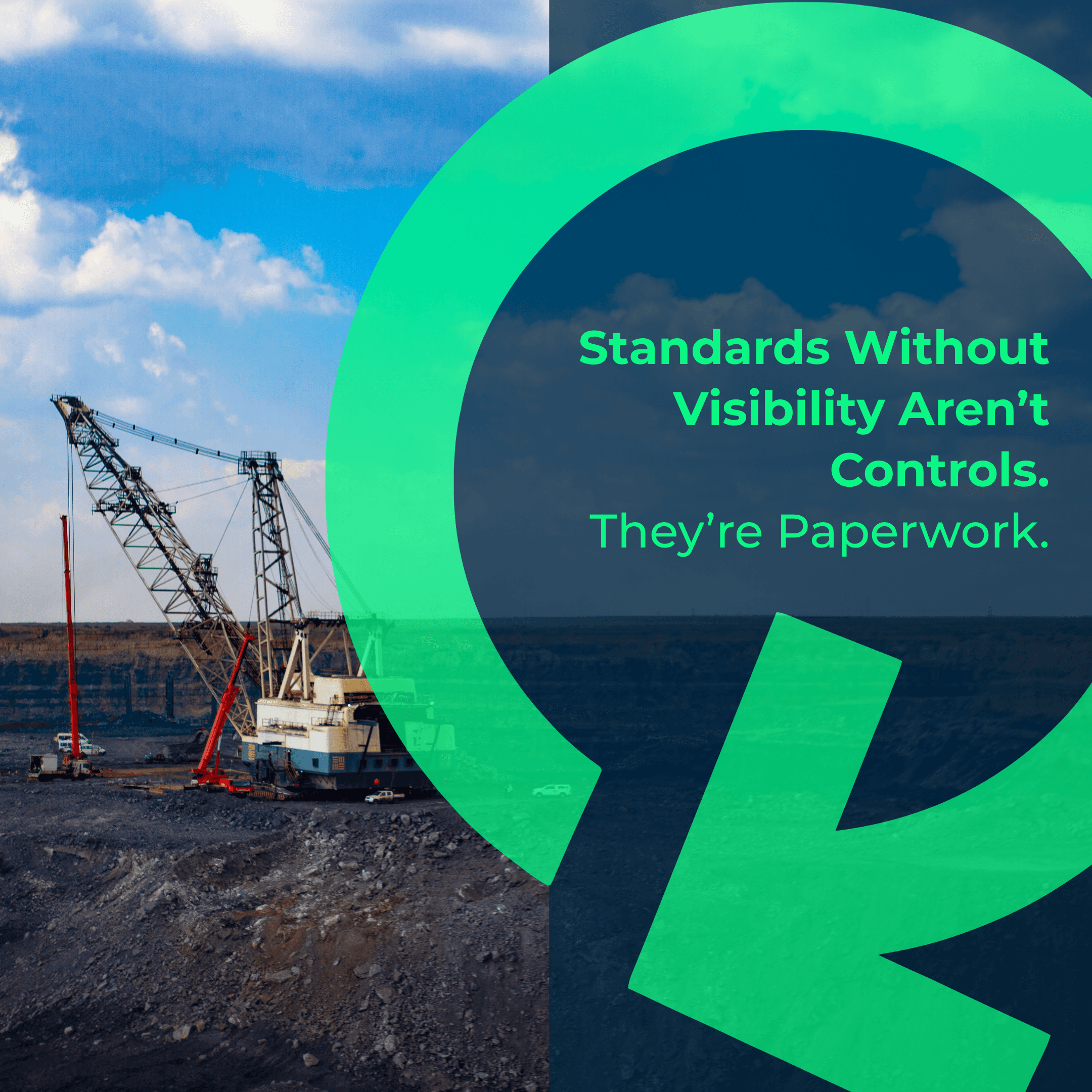
Standards Without Visibility Aren’t Controls. They’re Paperwork.
Mar 13, 2026
In Australian mining and heavy industry, most organisations do not suffer from a lack of standards.
They suffer from a lack of visibility.
Across operations, there are manuals, procedures, critical control frameworks, isolation standards, maintenance strategies, and audit schedules. On paper, the environment often looks mature and well governed.
Yet incidents still occur. Audit findings repeat. Assurance teams chase evidence. Leadership is surprised by issues they assumed were under control.
The uncomfortable truth is this: written standards do not equal effective controls.
Without clear, timely visibility of execution across sites, standards become paperwork rather than protection.
The Illusion of Control
A control only exists if it is:
Executed as intended
Verified with evidence
Visible to the people accountable for risk
When visibility breaks down, controls become assumptions.
In multi-site mining operations, this breakdown is common. Standards are defined centrally, but execution happens locally. Evidence is captured inconsistently. Reporting is often delayed, summarised, or filtered through site-level lenses.
From a distance, everything appears compliant. In reality, leaders are relying on lagging signals, not control assurance.
Where Visibility Fails in Practice
In our experience working with multi-site operations, visibility gaps tend to emerge in predictable ways.
Execution happens, but cannot be seen. Critical inspections are completed, permits are issued, and maintenance tasks are performed, but there is no real-time enterprise view. Leaders cannot answer basic questions without calling sites or pulling reports.
Evidence exists, but cannot be trusted quickly. Photos, checklists, and sign-offs sit in multiple systems, spreadsheets, inboxes, or personal drives. Retrieving proof becomes a manual exercise, often triggered only when auditors ask.
Accountability weakens over time. FIFO and DIDO rosters change. Contractors rotate. Actions lose owners. What was once “in progress” quietly becomes overdue.
Standards drift between sites. Each site interprets procedures slightly differently. Variations are not visible until audits or incidents expose them.
None of this indicates poor intent or weak capability. It indicates lost visibility.
Why This Matters More in Australian Mining
Australian mining operations face structural realities that amplify these risks:
Remote and geographically dispersed sites
Heavy reliance on FIFO and DIDO labour
Complex contractor ecosystems
Increasing regulatory and assurance expectations
In this environment, you cannot manage asset compliance by exception or by periodic review. Visibility must be continuous, comparable, and enterprise-wide.
Otherwise, leadership is effectively blind between audits.
Controls Must Be Seen to Be Trusted
Effective controls are not defined by how well they are written. They are defined by how clearly they can be seen.
Leading operators are shifting their focus away from documentation volume and toward visibility quality. They are asking different questions:
Can we see execution across all sites today, not last month?
Can we verify evidence without manual chasing?
Can we identify overdue actions before they become audit findings?
Can we maintain accountability despite workforce changes?
When standards are directly linked to execution and evidence, confidence increases. Risk discussions become factual rather than reactive. Audits confirm what leaders already know instead of revealing surprises.
The Cost of Invisible Non-Compliance
When visibility is poor, exposure accumulates quietly. Best case, this shows up as inefficiency and minor findings. In a typical year, it becomes remediation cost, repeat audit issues, and operational distraction. In the worst case, it escalates into incidents, regulatory action, and reputational damage.
The standards were there. The intent was right. The visibility was missing.
A Question for Leaders
Right now, without checking systems, can you confidently say:
Which critical asset controls were executed yesterday across all sites?
Where compliance actions are ageing or overdue?
Which sites carry the highest unresolved asset compliance risk?
If not, the issue is not standards. It is visibility.
Closing Thought
Standards without visibility are not controls. They are paperwork.
In multi-site mining operations, resilience comes not from how much you document, but from how clearly you can see execution, evidence, and accountability across every site, every day.
If visibility improves, assurance follows. If it does not, exposure remains.
About Quartile 5: Quartile 5 helps Australian mining and heavy industry operations shift from assumed compliance to visible control execution. Our asset audit and compliance management platform gives leadership clear, enterprise-wide visibility of control execution and evidence across all sites so standards function as protection, not paperwork.